Krantz’s father’s double murder
The Best Werewolf Short Stories 1800-1849Krantz’s father’s double murder is the decisive crime behind Krantz’s family history and exile. It begins with an unequal social order, becomes an act of jealous violence when a husband discovers his wife’s affair, and ends by transplanting the surviving family from Transylvania to the remote Hartz Mountains. The episode therefore joins domestic betrayal to class oppression and makes flight, secrecy, and inherited trauma the conditions of Krantz’s earliest life.
Social Position and Family Background
Krantz’s father was originally a serf belonging to a wealthy Hungarian nobleman in Transylvania. Serfdom did not make him poor or ignorant: he had accumulated wealth, possessed intelligence and respectability, and had been elevated by his lord to the position of steward. Yet his advancement could not alter his legal and social condition. Whoever was born a serf, Krantz explains, remained a serf, even after becoming prosperous. The murder thus occurs within a system in which personal worth and material success offer no protection against inherited subordination.
The family itself had been established before the crime. Krantz’s father had been married for about five years and had three children: the eldest son, Cæsar; Krantz, whose given name was Hermann; and a daughter, Marcella. Their Latin-derived names reflect the cultural circumstances of the country, where Latin was still spoken. These details give the later violence a domestic scale: the act is not an isolated quarrel between strangers but the destruction of the household on which three children depend.
Discovery of the Affair
Krantz’s mother was very beautiful, but the narrative presents her beauty as accompanied by a failure of virtue. The lord of the soil saw and admired her, and the imbalance between ruler and serf made the affair inseparable from authority. While Krantz’s father was away on a mission, the nobleman pursued her through flattery and persistent attention until she yielded to his wishes.
The father’s return was unexpectedly timed. He found his wife in the company of her seducer, and the evidence of the affair appeared conclusive. The discovery transforms a hidden relationship into an immediate confrontation. The narrative gives no extended legal or moral debate before the violence; instead, the certainty of what he has witnessed and the intensity of his feelings propel him toward revenge against both participants.
The Double Murder and Flight
Carried away by what Krantz calls the impetuosity of his feelings, his father waited for an opportunity when the two lovers would meet and murdered them both. The victims were therefore his wife and the nobleman who had seduced her. The crime is simultaneously personal and political: it answers an intimate betrayal, but it is committed against a powerful lord by a man whose condition as a serf leaves him especially vulnerable to official retaliation.
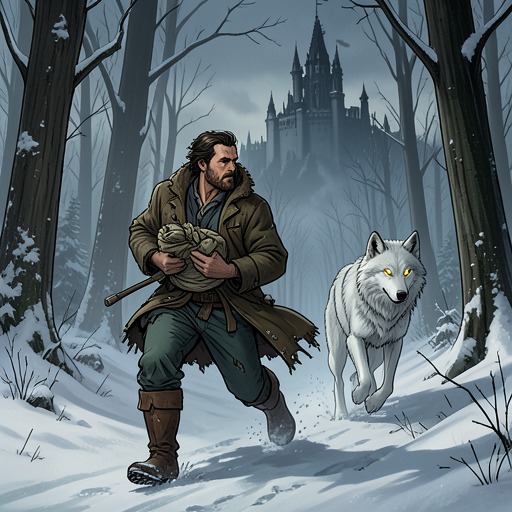
The father understood that his status would prevent the provocation from being accepted as a justification. He gathered whatever money he could find, harnessed his horses to a sleigh, and, in the depth of winter, left in the middle of the night with Cæsar, Krantz, and Marcella. His preparations are practical rather than ceremonial. Money, transport, darkness, and the children become the instruments of survival, while the winter journey gives the escape an urgency that matches the crime’s danger.
He also knew that remaining anywhere in his native country would leave him within reach of the authorities. Pursuit was expected, and escape seemed impossible if he stayed in territory where officials could seize him. He therefore continued without interruption until he had hidden himself and his children in the secluded intricacies of the Hartz Mountains. The family’s relocation is not a voluntary search for a new home but an enforced disappearance, produced by the collision between murder and the rigid hierarchy of serfdom.
Reconstructed Memory and Lasting Consequences
Krantz emphasizes that the account of the murder was learned afterward; it does not belong to his direct childhood memory. His own earliest recollections begin only after the flight, in a rough but comfortable cottage on the edge of the vast forests of northern Germany. The narrative consequently separates inherited knowledge from lived memory: the crime is the foundation of his story, while the isolated cottage is the first landscape he can personally recall.
The new household survives on a few acres cultivated during summer, although the harvest is uncertain. In winter the children remain indoors while their father follows the chase, and wolves prowl incessantly around the dwelling. The cottage, purchased from a forester who hunted and burned charcoal to smelt ore from neighboring mines, stands about two miles from any other habitation. Its distance from human settlement preserves the family from immediate discovery but also turns exile into a permanent condition of isolation.
The double murder thus has consequences beyond the deaths of the two adults. It removes the family from Transylvania, fixes the father in concealment, and places Cæsar, Krantz, and Marcella inside a precarious frontier existence. The remote forest household is both refuge and afterlife of the crime: a place where the children can grow beyond the reach of the authorities, yet where the danger of pursuit has been replaced by poverty, solitude, winter, and wolves.